The Journey of an Aluminium Profile: From Design to Finished Product

The Journey of an Aluminium Profile: From Design to Finished Product
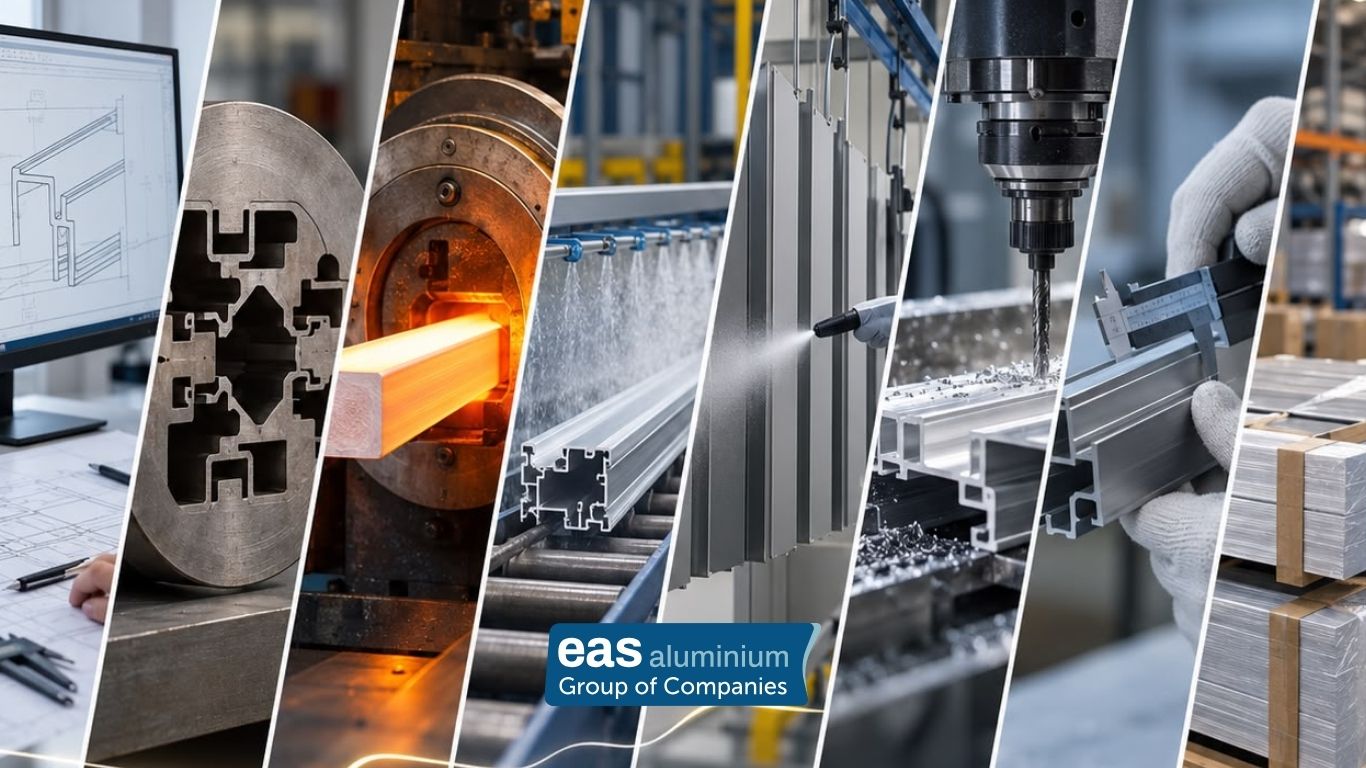
The production of an aluminium profile is a multi-stage engineering process that begins long before the material reaches the extrusion press. From interpreting customer drawings and designing the extrusion die to profile extrusion, surface treatment, CNC machining, quality control and final packaging, each stage has a direct impact on the dimensional accuracy, surface quality and performance of the finished product.
At EAS Aluminium, this process is managed through an integrated production structure designed to transform customer requirements into reliable, application-specific aluminium solutions.
From Customer Requirements to a Production-Ready Design
Every project begins with understanding the technical requirements behind the profile.
Customer drawings, dimensions, tolerances, cross-sectional geometry and intended applications are reviewed by EAS Aluminium’s technical teams. At this stage, the profile is evaluated not only according to its final appearance but also according to its manufacturability and the technical requirements of the extrusion process.
The geometry of an aluminium profile can directly influence material flow during extrusion, dimensional stability, cooling behaviour and subsequent machining operations. For this reason, the transition from a customer drawing to a production-ready profile requires careful technical evaluation.
Where required, design adjustments can be considered to achieve a suitable balance between the customer’s functional requirements and the technical parameters of the manufacturing process.
Die Manufacturing: Where Profile Geometry Takes Shape
Once the design has been technically evaluated, the extrusion die becomes one of the most critical elements of the production process.
The die determines the cross-sectional geometry through which the aluminium is formed during extrusion. Complex profiles, hollow sections, multi-chamber geometries and application-specific designs require careful die preparation and manufacturing.
At EAS Aluminium, die manufacturing forms an important part of the integrated production structure. Keeping this stage closely connected with the subsequent extrusion process allows technical requirements to be evaluated throughout the transition from design to production.
The quality and precision of the die can have a direct influence on profile dimensions, surface characteristics and production stability. For this reason, die manufacturing is treated as a fundamental part of the overall profile development process rather than as an isolated production step.
Extrusion: Transforming Aluminium into a Profile
The extrusion process is where the aluminium billet is transformed into the required profile geometry.
During extrusion, the heated aluminium billet is forced through the specially manufactured die under controlled pressure. As the material passes through the die opening, it takes on the required cross-sectional shape.
The process requires control of several parameters, including material temperature, extrusion speed, pressure and cooling conditions. Maintaining the appropriate balance between these parameters is essential for achieving dimensional consistency and stable production.
EAS Aluminium has an annual production capacity of 20,000 tonnes and the capability to manufacture more than 9,000 different aluminium profile options, including profiles of up to 15 metres in length. This production capability enables the company to address a broad range of requirements across architectural, construction, transportation, automotive, energy and industrial applications.
From Extrusion to Controlled Cooling and Further Processing
After exiting the die, the newly formed profile must be cooled and prepared for subsequent operations.
Cooling plays an important role in maintaining the dimensional stability and mechanical characteristics of the extruded profile. Controlled process conditions help ensure that profiles maintain the required geometry as they move through the production line.
Depending on the application, the profiles can subsequently be cut to specified lengths and prepared for surface treatment or further machining.
The ability to maintain control across these interconnected stages is particularly important for profiles with complex geometries, tight dimensional requirements or long lengths.
Surface Treatment: Protecting Performance and Appearance
For many applications, the extrusion process represents only one stage of the finished product.
EAS Aluminium provides surface treatment solutions including anodizing and electrostatic powder coating, depending on the technical and aesthetic requirements of the project.
Anodizing creates a controlled oxide layer on the aluminium surface and can provide enhanced surface characteristics while maintaining the material’s metallic appearance.
Electrostatic powder coating, on the other hand, enables aluminium profiles to be finished in a wide range of colours and surface specifications. EAS Aluminium operates a powder coating system incorporating WAGNER technology, supporting controlled and consistent coating applications.
Surface treatment is therefore not considered simply as a final aesthetic operation. The selected treatment is evaluated according to the intended application, environmental conditions, appearance requirements and expected performance of the profile.
CNC Machining for Application-Specific Requirements
Modern aluminium applications increasingly require profiles that are ready for direct integration into a finished product or system.
For projects requiring additional operations, EAS Aluminium can apply CNC machining processes to aluminium profiles. Operations such as cutting, drilling and other application-specific machining can be carried out according to the technical requirements of the project.
This approach allows profiles to move beyond standard extrusion and become more application-ready components.
By combining extrusion with downstream processing, the production process can be adapted to the requirements of sectors where dimensional accuracy, repeatability and compatibility with the final assembly are critical.
Quality Control Across the Manufacturing Process
Quality is not limited to the final inspection stage.
For an aluminium profile to perform as intended, dimensional accuracy, surface condition, geometry and processing quality must be monitored throughout the manufacturing chain.
EAS Aluminium follows quality control procedures across its production processes, supporting consistency from the initial manufacturing stages through to the finished product.
The company operates in accordance with recognized quality and industry standards, including ISO 9001:2018 and Qualicoat, while its products and processes are supported by the relevant certifications and compliance requirements for the markets and applications served.
This process-oriented approach allows potential deviations to be identified and addressed before the product reaches the final stage.
Packaging: The Final Stage Before Delivery
Once manufacturing and quality control are completed, the profile enters the final stage of its journey: packaging and preparation for shipment.
Aluminium profiles can be long, lightweight and susceptible to surface damage if handled or packaged incorrectly. For this reason, packaging is an important part of maintaining product quality after manufacturing.
Profiles are prepared according to their characteristics and transportation requirements, with attention given to protecting surfaces and maintaining the integrity of the products during handling, loading and international transportation.
For a company serving customers across more than 40 countries, reliable packaging and logistics are an essential extension of the production process.
An Integrated Approach to Aluminium Profile Manufacturing
The journey of an aluminium profile demonstrates how many interconnected engineering and manufacturing decisions are required before a finished product reaches the customer.
At EAS Aluminium, customer requirements are transformed through a sequence of connected processes: technical evaluation, die manufacturing, extrusion, cooling and cutting, surface treatment, CNC machining, quality control, packaging and delivery.
With an annual production capacity of 20,000 tonnes, more than 9,000 profile options, production capability for profiles up to 15 metres, and an integrated manufacturing structure, EAS Aluminium serves customers across multiple industries and international markets.
From the first technical drawing to the final packaged profile, every stage contributes to the performance and reliability of the finished product.
For EAS Aluminium, every profile is more than an extruded section. It is the result of engineering, process control, manufacturing expertise and a commitment to delivering solutions tailored to the customer’s requirements.