


How an Aluminium Extrusion Die Is Made: From Drawing to First Trial

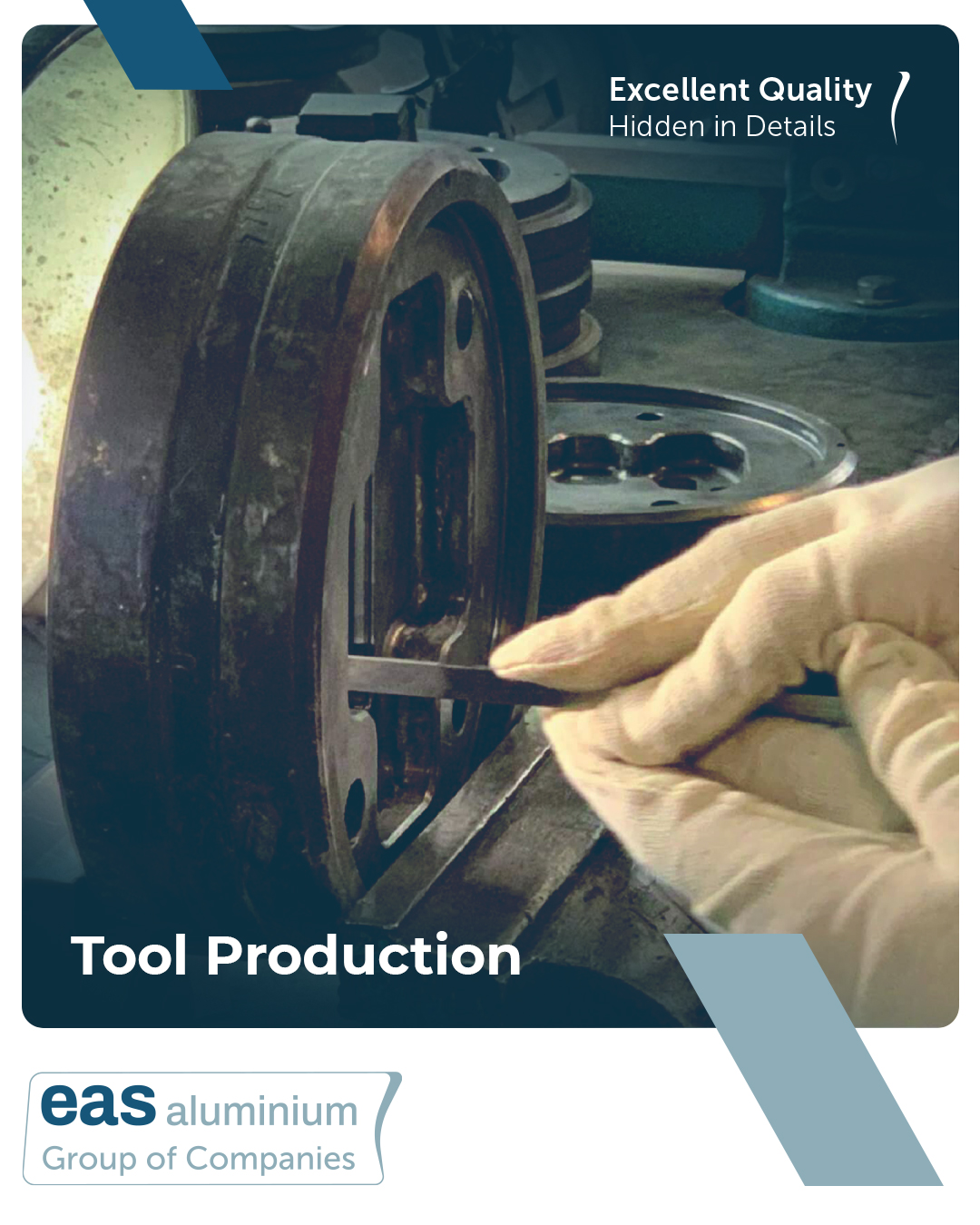
Short answer: An aluminium extrusion die is a hardened steel tool with an opening shaped like the cross-section of the profile. It is made in five steps: the customer drawing is reviewed, the die is designed, the steel is machined, the die is heat-treated and surface-hardened, and it is proven in a first trial on the press, with corrections if needed. Each step decides how closely the finished profile will match your drawing.
Every aluminium profile starts as a die. Before a single metre is extruded, the tool has to be designed around the geometry of your section, cut from steel, hardened and tested under real press conditions. For a buyer or engineer, knowing what happens in each step makes it easier to brief a supplier, to plan lead time for a new profile and to understand why a first sample sometimes needs a correction.
This guide follows a die from the drawing on your desk to the first trial on the press.
1. The drawing is reviewed
The process starts with your technical drawing. Before any steel is cut, the die maker and the extrusion team check whether the section can be extruded as drawn and what it will take to hold the tolerances you need. Typical questions at this stage are:
- Wall thickness: are the walls thick enough for the alloy and the size of the section, and are they reasonably uniform?
- Enclosed voids: does the profile have closed chambers? That decides whether a solid or a hollow die is needed.
- Tongues and thin details: long, narrow gaps or fins put high stress on the die and may need a design change.
- Tolerances and functional surfaces: which dimensions matter for assembly, and which faces will be visible after powder coating or anodising?
- Alloy and temper: 6060 and 6063 flow easily; 6005A and 6082 are stronger but harder to push through the die.
The result of this review is either a confirmation that the section can be made as drawn or a short list of suggested changes. Small changes at this point, such as a slightly larger radius or a more even wall, often make the die more robust and the profile more consistent.
2. The die is designed
In die design, the profile cross-section becomes a tool. The designer decides where the opening sits on the die face, how many openings (cavities) the die will have, and how the aluminium will be fed to each part of the section.
The most important design parameter is the bearing: the short land around the die opening that the aluminium slides along as it leaves the die. Thick walls flow faster than thin walls, so the bearing length is varied around the opening to slow down the fast-flowing areas and let the thin areas keep up. Balanced flow is what keeps a profile straight and dimensionally stable.
For profiles with enclosed chambers, the die has two parts: a mandrel that forms the inside of the chamber and a die plate that forms the outside. We explain the difference between solid, semi-hollow and hollow dies in a separate guide.
3. The steel is machined
Most extrusion dies are made from hot-work tool steel, a grade designed to keep its strength at the temperatures reached during extrusion. Machining is done in stages:
- Turning and milling give the die its outer shape and the feeder pockets that guide the metal.
- Wire EDM (electrical discharge machining) cuts the precise opening of the profile.
- Bearing finishing sets the bearing lengths defined in the design and gives the bearing surfaces their final finish.
Every die is checked against the drawing before it moves on. Machining is slow and deliberate work: small differences in the bearings show up later as differences in the profile.
4. Heat treatment and surface hardening
After machining, the die is heat-treated to reach the hardness it needs in service. The bearing surfaces are then usually surface-hardened, most commonly by nitriding. A hard surface layer reduces wear as hot aluminium slides over the bearings and helps the die keep its dimensions over many production runs. Nitriding is also repeated as part of maintenance during the life of the die.
Have a profile drawing?
Send it to us. We review geometry, wall thickness and tolerances and come back with a feasibility assessment and a die proposal.
5. The first press trial
A new die is proven on the press before serial production. The die is preheated in a die oven, mounted in the press and the first billets are extruded. The trial profile is then measured against the drawing and checked for straightness, wall thickness and surface.
If a dimension is out or the profile does not run straight, the die goes back to the die shop for correction, typically by adjusting bearings, and is tried again. A first trial that needs a correction is normal, especially for complex sections. What matters for the buyer is how quickly that loop closes.
What this means for you as a buyer
- Lead time: for a new profile, the die is the first item on the critical path. A clear, complete drawing shortens the review and design steps.
- Accuracy: die design and bearing finishing determine how well the profile holds its tolerances, delivery after delivery.
- Cost: the more complex the section, the more complex the die. Design suggestions at the review stage can reduce both.
- Standard first: if a standard section fits your design, no new die is needed. Check our online catalogue of standard profiles first.
How EAS Aluminium makes dies
At EAS Aluminium, die production sits inside the same operation as extrusion. Design questions are settled directly between the die shop and the press team, not between two companies, and corrections after a trial come back to a die shop a few steps from the press. Our Presezzi extrusion line includes die ovens and nitrogen-assisted die cooling, which support stable conditions during the trial and in serial production.
Frequently asked questions
What is an aluminium extrusion die?
It is a steel tool with an opening in the shape of the profile cross-section. Heated aluminium is pushed through this opening by the extrusion press and leaves it as a continuous profile.
What material are extrusion dies made from?
Most extrusion dies are made from hot-work tool steel, which keeps its strength at extrusion temperatures. The bearing surfaces are usually nitrided to make them harder and more wear-resistant.
Why does a new die need a press trial?
Aluminium flows differently through thick and thin parts of a section. The trial shows how the real metal behaves in the die, so dimensions and straightness can be checked against the drawing and corrected before serial production.
Do I need a new die if a standard profile fits my design?
No. Standard profiles are extruded with existing dies, so no new tooling is needed. You can search standard sections by geometry and dimension in the EAS online catalogue.
What should I send to get a die proposal?
A technical drawing of the cross-section (DWG, DXF, STEP or PDF), the alloy and temper if known, the surface finish, the required length and an estimate of annual volume.
Start with your drawing
Send your section drawing for a feasibility review and a die proposal from our team.


